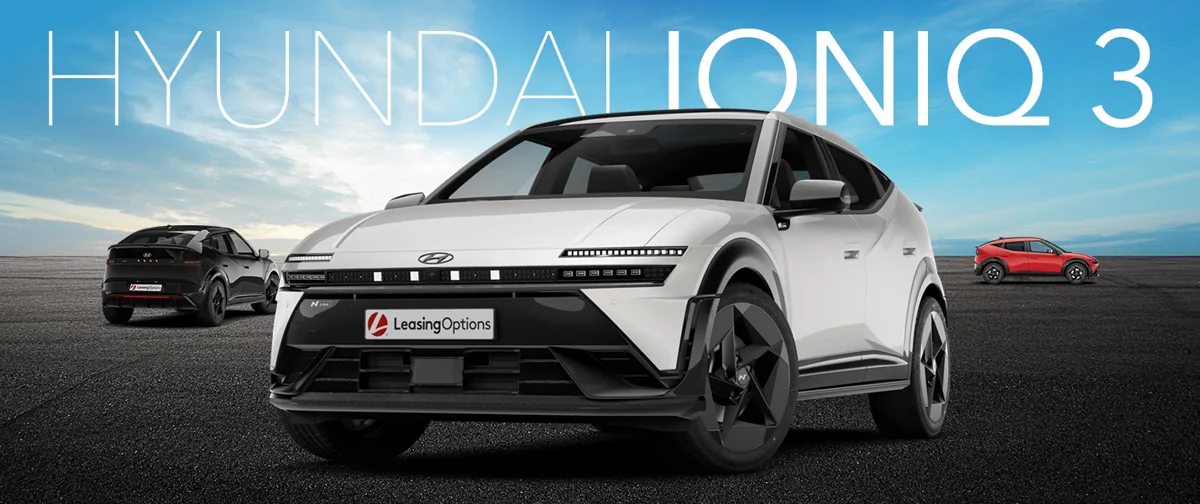

One of the biggest changes happening in the electric car market right now isn’t necessarily about cars getting faster, bigger or more luxurious. It’s about ordinary electric cars becoming considerably more useful.
And the new Hyundai IONIQ 3 could be a very good example of exactly that.
Hyundai’s latest electric car is a compact hatchback designed primarily for European drivers, but despite its relatively small footprint, the headline figure is a claimed driving range of up to 308 miles.
That is the sort of distance that, until fairly recently, tended to be associated with much larger and considerably more expensive electric cars.
Now it is arriving in a car designed to take on everyday family driving, commuting, school runs and longer journeys.
The IONIQ 3 sits below the IONIQ 5 in Hyundai’s electric range and measures just over 4.1 metres long, making it compact enough to be easy to live with around town.
But Hyundai has worked hard to make sure that being compact on the outside doesn’t translate into feeling cramped on the inside.
There are five proper seats, a flat floor and a long wheelbase designed to maximise passenger space, while the boot can hold up to 441 litres.
That makes the IONIQ 3 an interesting proposition because it sits somewhere between the traditional electric supermini and the larger family hatchback.
In other words, it could potentially give drivers the easier dimensions of a smaller car without asking them to give up too much practicality.
It looks a little different too.
Hyundai calls the shape an ‘Aero Hatch’, with a sloping roofline, prominent rear spoiler and styling designed to reduce aerodynamic drag while creating as much usable interior room as possible.
It also introduces Hyundai’s latest ‘Art of Steel’ design language, so expect some of the ideas seen here to start appearing on other Hyundai models in the future.
The more important story for most drivers, however, is underneath.
Two battery sizes are available.
The 42.2kWh battery offers a claimed range of up to 213 miles, while stepping up to the larger 61kWh battery increases that to as much as 308 miles.
That choice makes sense for the way people actually use their cars.
A driver covering relatively short daily distances may have little need to pay for additional battery capacity they rarely use, while somebody regularly travelling longer distances can choose the larger battery and gain the extra flexibility.
It is another indication of how the electric car market is beginning to mature.
Rather than simply offering one EV with one battery and asking everyone to make it work, manufacturers are increasingly giving drivers different options depending on how they actually travel.
Charging should be straightforward too.
Hyundai says a rapid DC charger can take the smaller battery from 10 to 80 per cent in around 29 minutes, while the larger 61kWh version takes around 30 minutes.
As always, those figures depend on using an appropriate charger and real charging speeds can vary according to factors including battery temperature, weather conditions and the charge already remaining.
But for most drivers, around half an hour for a substantial rapid charge should fit much more naturally into a longer journey than the charging times associated with some earlier generations of electric cars.
The IONIQ 3 also comes with some clever technology that has previously tended to appear further up the EV market.
Vehicle-to-Load functionality, better known as V2L, means electricity stored in the car’s battery can be used to power external electrical equipment.
There is also an integrated EV route planner designed to help with charging on longer journeys, Plug & Charge capability and Hyundai Digital Key 2, which can allow compatible smartphones and wearable devices to be used to access the car.
The IONIQ 3 is also the first Hyundai model in Europe to introduce the company’s new Pleos Connect infotainment system, which is based on Android Automotive.
But perhaps the most interesting thing about the IONIQ 3 isn’t any individual piece of technology.
It is what the whole package says about the direction electric cars are heading.
For a long time, switching to an EV could involve accepting some kind of compromise.
Smaller electric cars could be excellent around town but sometimes offered limited range. Cars capable of travelling much further tended to be larger, heavier and more expensive.
That distinction is becoming increasingly blurred.
An electric hatchback offering the potential to cover more than 300 miles between charges, while still providing five seats and a useful family-sized boot, is a very different proposition.
It also matters for drivers considering their next car through leasing.
One of the benefits of the rapidly expanding EV market is that there is no longer a single type of electric car.
Drivers can now choose from compact city cars, hatchbacks, estates, family SUVs, performance cars and luxury models, with a growing number offering ranges that make longer journeys far less intimidating than they once were.
The IONIQ 3 adds another option to that list and, perhaps more importantly, brings some of that longer-range capability into a size of car that should suit a much wider group of drivers.
Hyundai is now accepting UK reservation requests for the new IONIQ 3, with the model joining a growing electric line-up that already includes the INSTER, KONA Electric, IONIQ 5, IONIQ 6 and IONIQ 9.
The official UK figures currently quote up to 308 miles of driving range, although Hyundai notes that final technical data and range figures remain subject to final homologation.
And that is probably the biggest takeaway from the IONIQ 3.
A 300-mile electric car no longer has to mean a huge battery packed into a huge SUV.
Increasingly, it can simply mean a practical hatchback you could use every day.
For drivers who have liked the idea of going electric but have been waiting for smaller EVs to offer a little more flexibility, the IONIQ 3 could be one to watch.
Explore the latest electric car leasing deals from Leasing Options and find the EV that works for you.


