

The UK’s roads are under increasing pressure and potholes have become an unavoidable part of many everyday journeys. Whether you’re commuting, travelling for work or simply running errands, the condition of the roads plays a significant role in both safety and cost. For motorists exploring car leasing options, reliability and running costs are often front of mind, and the growing pothole problem is becoming harder to ignore.
To find out more, we carried out a study that reveals the worst cities for potholes in the UK. This will help you to understand how much they’re costing drivers and how to navigate them safely.
The state of Britain’s roads: Where potholes are most common
Across the UK, potholes are a persistent and widespread issue. In the past year alone, a staggering 1,898,650 potholes have been filled nationally. That equates to 5,203 repairs every single day, at a total cost of £137.4 million. While this effort is significant, it also highlights the scale of the challenge, with many areas still struggling to keep up with demand.
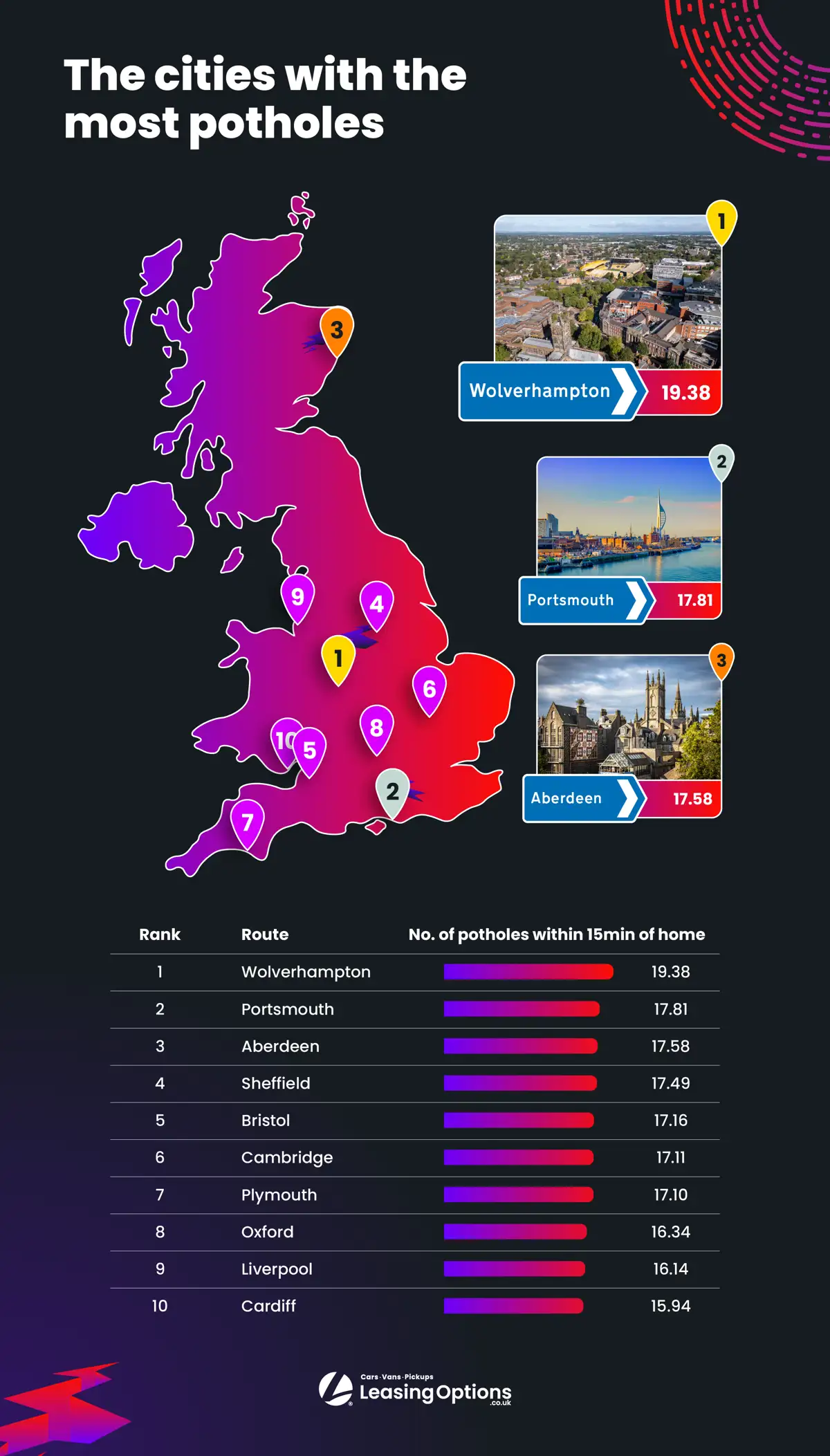
Wolverhampton stands out with an average of 19.38 potholes per street, making it the worst affected city in the UK for sheer volume. However, the issue is far from isolated, with many other major cities experiencing similarly high figures.
The impact isn’t just physical but also emotional and financial. In Liverpool, 16% of residents say they’ve considered moving home because of potholes, followed by Brighton & Hove and London, each at 15%. This highlights a growing cost-of-living concern, where ongoing vehicle damage and frustration are pushing people to rethink where they live.
Younger drivers appear to be feeling this most acutely, with those aged 25 to 34 spending an average of £417 on pothole-related repairs over two years. It’s a reminder that the cost of poor road maintenance extends well beyond inconvenience.
City analysis: Where the problem hits hardest
While potholes are widespread, different cities are experiencing the issue in different ways.
Wolverhampton ranks number one when it comes to the worst cities for potholes in the UK, reinforcing its position at the top of the list. For drivers here, encountering damaged roads is a near-daily occurrence.
Aberystwyth, however, tells a different story. Even though it doesn’t top the list for volume, it has the highest rate of vehicle damage, with 57% of residents saying potholes have affected their car. This suggests that severity, rather than just frequency, plays a major role in real-world impact.
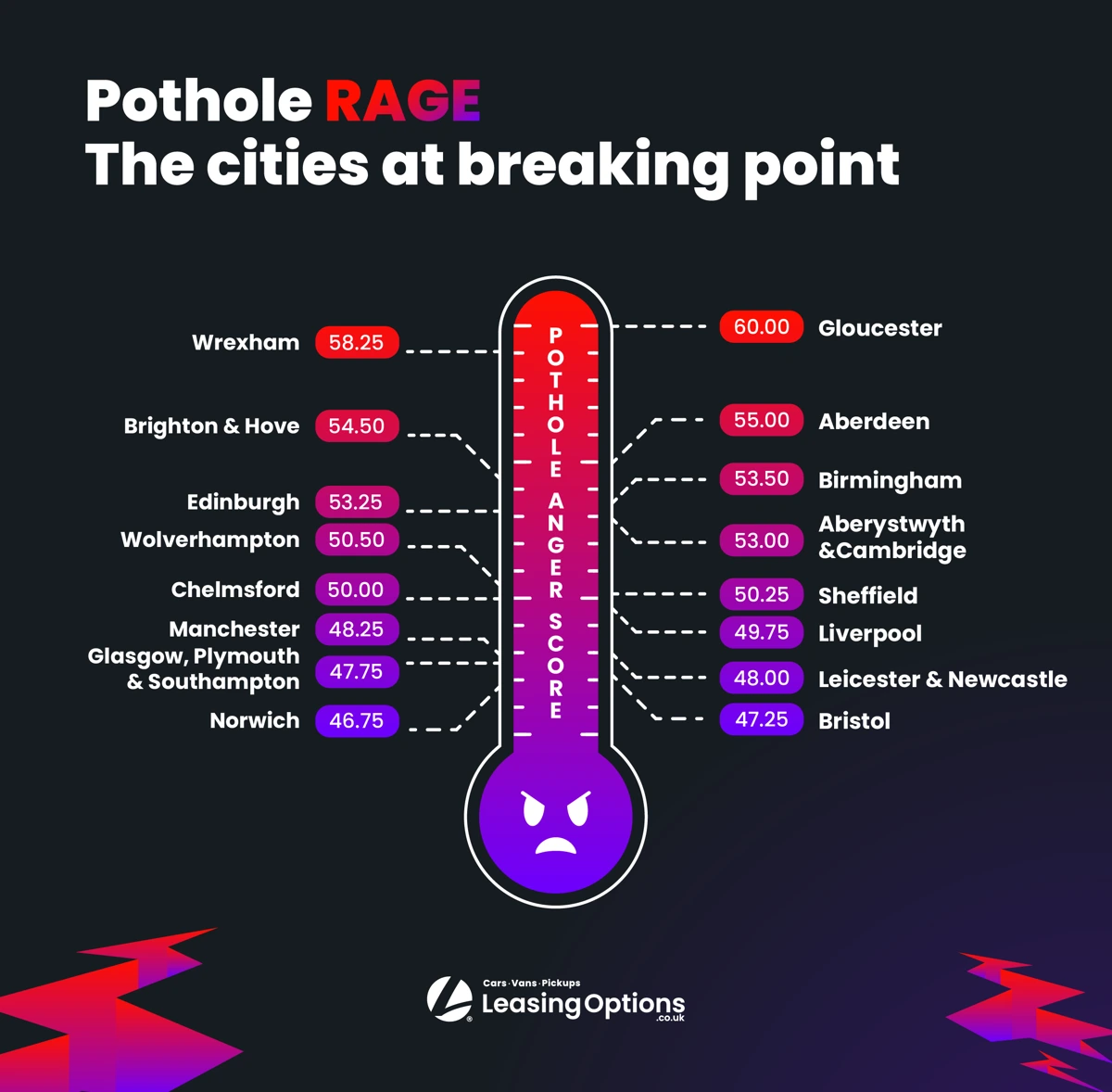
Gloucester emerges as the angriest city, with a pothole frustration score of 60 out of 100. Interestingly, this comes despite a lower number of potholes compared to other cities, showing that perception and experience can be just as important as raw figures.
On a more positive note, Leeds stands out as the city best at reporting and responding to potholes, with a repair response score of 54.5 out of 100. While there’s still room for improvement, the city demonstrates that effective systems can make a big difference.
Accessibility and the hidden impact of potholes
Beyond vehicle damage and driver frustration, potholes also present a significant accessibility challenge.
In Portsmouth, 66% of disabled residents report that potholes cause them problems, which is the highest proportion of any city in the UK. This is because uneven surfaces can make pavements and crossings difficult to navigate, creating barriers to everyday mobility.
Aberystwyth and Brighton & Hove follow closely, with 57% of disabled residents in both cities affected. This highlights an often-overlooked aspect of road maintenance, where poor conditions can disproportionately impact those who rely on accessible infrastructure the most.
The key takeaway here is that addressing potholes isn’t just about protecting vehicles, as it’s also about ensuring safe and inclusive environments for everyone.
Are councils spending effectively on pothole repairs?
Local authorities across the UK are investing heavily in road maintenance, but questions remain about how effectively that money is being used.
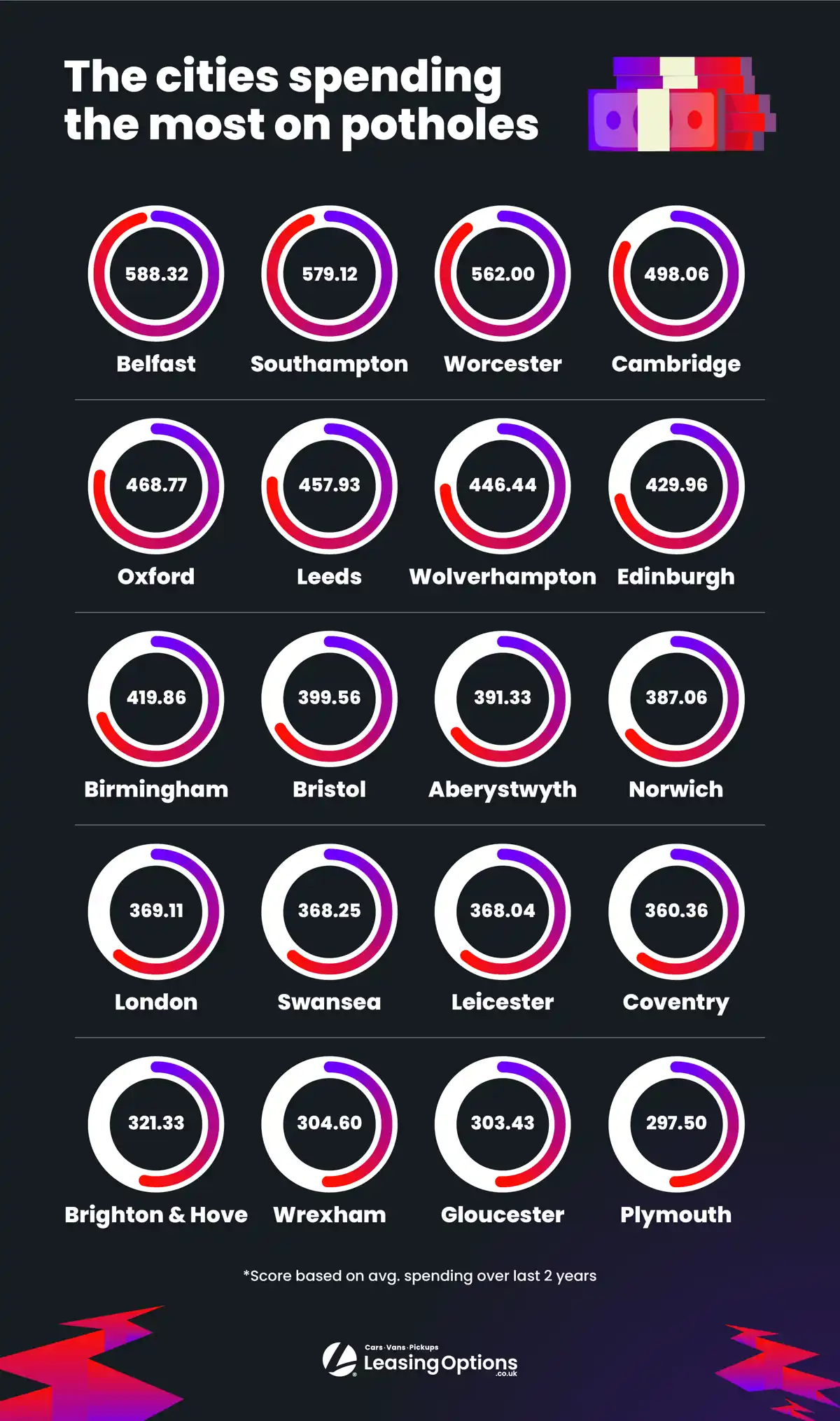
Belfast spends the most at £588 per person, yet it ranks ninth out of 30 for repair response, with a score of just 41 out of 100. This shows that even in cities which aren’t always considered the worst cities for potholes in the UK, inefficiencies can still affect outcomes.
Reactive repairs are known to cost 54% more than planned maintenance, with an average of £56.94 per pothole for planned work. In London, reactive repairs can reach £106.52, which is nearly double the cost.
The wider financial picture reinforces this concern. On top of the £137.4 million spent on repairs, a further £37.3 million is spent on compensation payouts and processing claims. That means 27p of every £1 spent on potholes is going towards the consequences, rather than fixing the issue itself.
The backlog is also a major challenge. It’s estimated that it would take 12 years to clear the carriageway maintenance backlog across the UK, rising to 13 years in Wales specifically. Each local authority faces an average one-off cost of £99.5 million to address this, alongside an average annual budget shortfall of £7.4 million.
Delays in repairs further highlight the strain on resources. In Sheffield, it takes an average of 125.8 days, over four months, to fix a reported pothole. During that time, the risk of damage and disruption continues to grow.
Pothole rage: Which cities are at breaking point?
No matter where you go, potholes continue to drive motorists round the bend. Across the UK, frustration is building, with some cities reaching particularly high levels of anger.
Gloucester tops the list with a pothole anger score of 60 out of 100, reflecting a strong sense of dissatisfaction despite not having the highest number of potholes. This suggests that frustration isn’t limited to the worst cities for potholes in the UK but felt nationwide. Wrexham comes in second (58.25), followed by Aberdeen (55), Brighton and Hove (54.5), and Birmingham (53.5).
In response to ongoing frustration, some residents have taken matters into their own hands, filling potholes with materials such as sand, gravel, concrete, stones, coal and tar. While this demonstrates the scale of the issue, it also raises important safety concerns.
Mike Thompson, Chief Operating Officer at Leasing Options, advises caution: “Though it may be tempting to fix a pothole independently, doing so can be unsafe and may even be unlawful if it interferes with public highways or creates further hazards. Potholes should always be reported to local authorities, who are equipped to handle repairs safely and in line with regulations.”
What are drivers really saying about potholes?
New customer survey data from Leasing Options highlights just how deeply potholes are affecting motorists across the UK.
The majority of respondents rated their frustration with potholes between 8-10 out of 10, with 10 being the most common score. On top of this, 57.4% said their vehicle had been damaged or needed repairs due to potholes. And among those who paid for repairs, the average bill came to around £458, underlining the significant financial impact poor road conditions can have. One respondent even reported spending £1,280 after suffering a tyre blowout on the M1 caused by a pothole.
The issues extend beyond vehicle damage too, with 45.7% of respondents saying potholes had caused accessibility or mobility-related difficulties for themselves or someone they know. Several respondents reported suffering injuries caused by potholes too, including twisted ankles, sprains, back injuries and cycling near-misses.
Frustratingly, while 59.6% of respondents said that they have reported a pothole to their local council, 48.2% expressed dissatisfaction with the response they received.
In some cases, frustration has become so severe that motorists are taking matters into their own hands, with 16.0% of respondents saying they know someone who has attempted to fill a pothole. 8.5% of respondents even said they were considering moving due to potholes, with another respondent considering leaving the country.
Discover your next motor with Leasing Options
The UK’s pothole problem is complex, affecting drivers, communities and local economies alike. While significant investment is being made, the data suggests that a more proactive and strategic approach could deliver better results.
Encouragingly, examples such as Leeds show that improvement is possible, particularly when reporting systems and response strategies are well managed. As awareness grows and solutions evolve, there’s an opportunity to create safer, smoother roads for everyone.
The key takeaway is that whether you live in one of the worst cities for potholes in the UK or a less affected area, road conditions remain a key consideration.
Now that you’re more informed on the national pothole situation, you’ll probably want to take a look at what car leases we have on offer. Alternatively, if you’re dealing with company cars, you’ll want to check out our business car leasing deals.
Be sure to speak with our team if you have any questions or require expert advice.
Methodology
One Poll Survey – 2,000 UK adults April 2026.
City Data from FOIs - Individual FOI Requests
Internal Leasing Options customer survey – 94 respondents April 2026.
National Data from ALARM Survey - https://www.asphaltuk.org/wp-content/uploads/ALARM-survey-2025.pdf
Road Quality Data - https://www.gov.uk/government/publications/local-road-maintenance-ratings/local-road-maintenance-ratings-2025-to-2026


