
For many people, driving represents independence and freedom. But for a significant number of UK motorists, getting behind the wheel can also bring stress, worry and even genuine fear. From motorway nerves to navigating unfamiliar city streets, driving anxiety is more common than many realise.
New survey data reveals just how widespread anxiety while driving has become – and which groups are most affected. In partnership with a driving psychologist, we explore why the fear of driving occurs, what triggers it, and practical ways drivers can rebuild confidence safely and steadily.
Young drivers are the most anxious on the road
One of the clearest patterns in the data is age. Drivers aged 18-24 are four times more likely than over-65s to experience driving anxiety frequently. 37% of 18-24s experience anxiety often (versus 9% overall). For over-65s, this falls to 3%.
For younger drivers, inexperience is often a major factor. According to our partnered driving psychologist, early driving years involve “heightened alertness and self-monitoring”. Younger motorists are still building automatic skills, meaning they’re more likely to overthink decisions and worry about making mistakes.
By contrast, older drivers benefit from decades of exposure to different road conditions. Confidence tends to grow as driving becomes second nature.
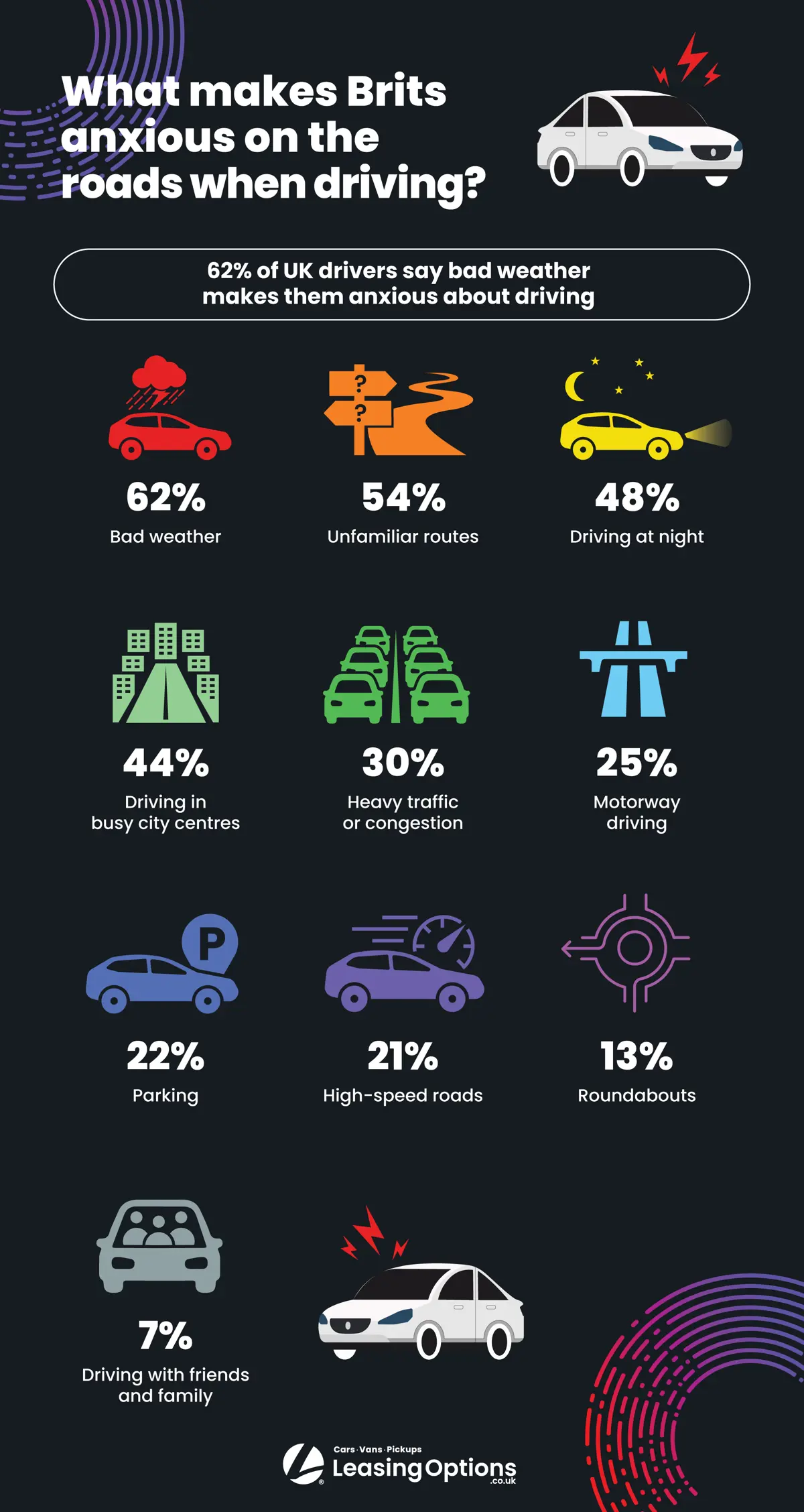
What are Brits most anxious about on the road while driving?
62% of UK drivers say bad weather makes them anxious about driving
Certain situations consistently trigger anxiety while driving. The most common concerns are linked to reduced visibility, unfamiliarity and perceived loss of control.
Driving situations that cause anxiety:
- Bad weather – 62%
- Unfamiliar routes – 54%
- Driving at night – 48%
- Driving in busy city centres – 44%
- Heavy traffic or congestion – 30%
- Motorway driving – 25%
- Parking – 22%
- High-speed roads – 21%
- Roundabouts – 13%
- Driving with friends and family – 7%
Bad weather tops the list, with nearly two-thirds of drivers reporting concern. Rain, fog and icy roads reduce visibility and grip, increasing the perceived risk of accidents.
Unfamiliar routes and busy city centres also rank highly. These environments demand quick decisions, awareness of signage and attention to other road users – all of which can heighten stress levels.
Motorway driving remains a common source of fear of driving, particularly for newly qualified drivers. Higher speeds and multi-lane traffic can feel overwhelming without regular exposure.
What triggers the most anxiety for drivers in the UK?
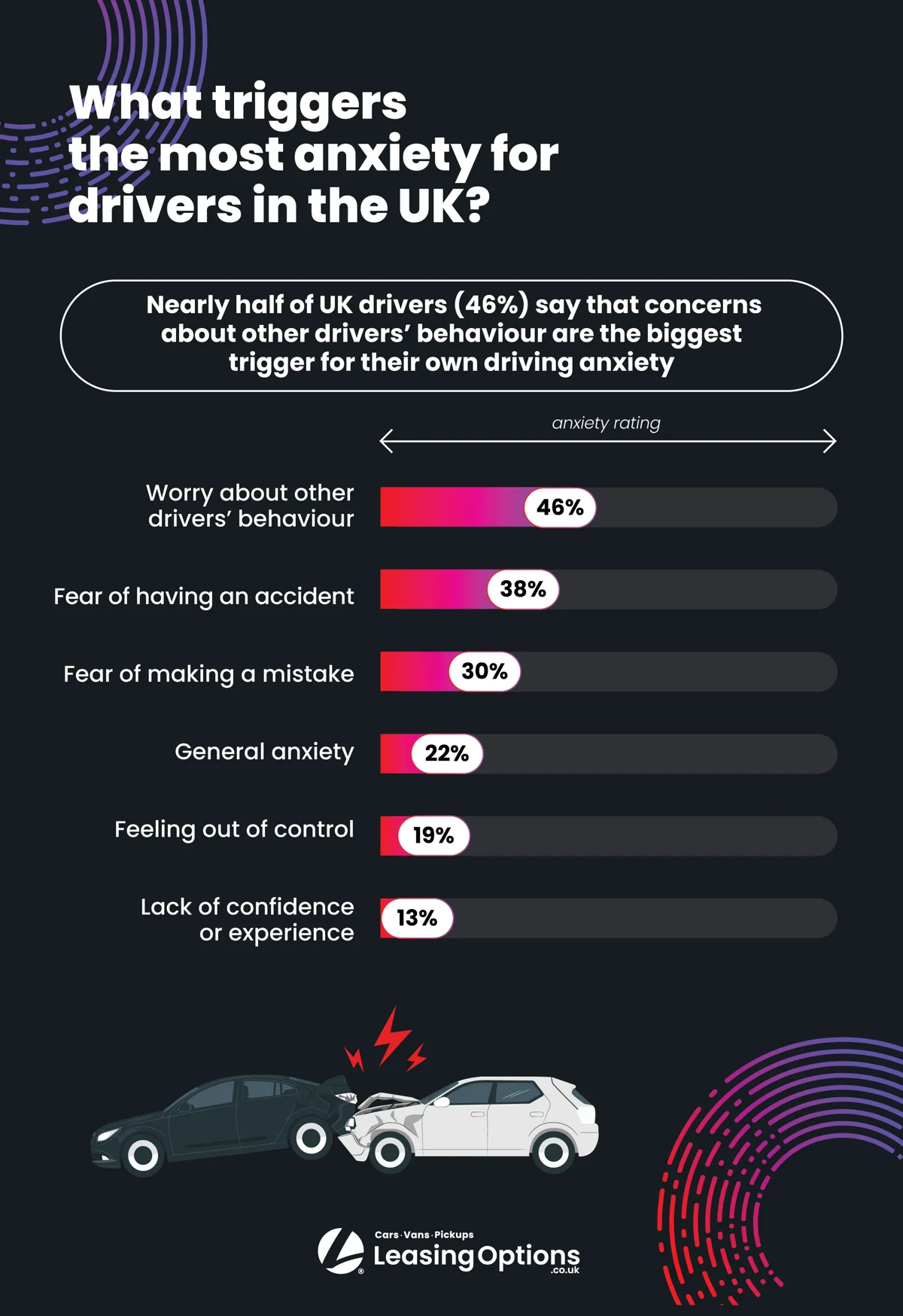
Nearly half of UK drivers (46%) say that concerns about other drivers’ behaviour are the biggest trigger
While specific situations play a role, the underlying causes of driving anxiety often relate to perception of risk and trust.
Top anxiety triggers:
- Worry about other drivers’ behaviour – 46%
- Fear of having an accident – 38%
- Fear of making a mistake – 30%
- General anxiety – 22%
- Feeling out of control – 19%
- Lack of confidence or experience – 13%
The psychologist explains that much of driving phobia stems from a lack of predictability. “When drivers feel they cannot control what others are doing, their brain moves into threat-detection mode. That can trigger physical symptoms such as increased heart rate, shallow breathing and muscle tension.”
Fear of making a mistake is also common, particularly among perfectionists or those who have previously experienced criticism while learning to drive.
Practical ways to build confidence
According to the expert, overcoming a fear of driving involves gradual exposure and cognitive reframing:
- Start small: Build confidence on short, familiar routes before tackling motorways or city centres.
- Practice controlled breathing: Slow breathing can reduce physical symptoms of anxiety.
- Reframe mistakes: View errors as learning experiences rather than evidence of failure.
- Drive at quieter times: Gradual exposure to busier roads helps reduce avoidance behaviour.
- Consider refresher lessons: Professional guidance can reinforce safe habits and restore confidence.
For some individuals, severe driving phobia may benefit from structured cognitive behavioural therapy (CBT).
London named one of Britain’s driving anxiety hotspots
Location also plays a role in anxiety levels, with the data showing that drivers in London are more likely than average to experience frequent anxiety – 15% against a national average of 9%. 13% say they feel anxious often and nearly half of London drivers would consider refresher lessons. High traffic density, complex junctions and congestion – plus congestion zones – may contribute to increased stress in the capital.
By contrast, North East drivers are among the calmest in the UK, with just 5% feeling anxious often, and 24% saying they never experience anxiety – a figure that is well above the national average. When it comes to the opposite of anxiety – confidence – 95% of drivers in Northern Ireland feel confident overall, among the highest.
Drivers want psychological support – not just better cars
Interestingly, when asked what would improve their confidence, drivers prioritised emotional and psychological tools over technology alone. When asked what would help them feel more confident, 27% said psychological coping strategies while 24% said enhanced vehicle safety systems. Another intriguing finding is that professional support (14%) and having a dashcam (17%) rank below knowing that other people are in the same boat (22%) – we like to know that other people feel the same as us.
Chief Operating Officer Mike Thompson comments: “It’s clear that confidence doesn’t just come from better vehicles – it comes from feeling supported. Whether that’s refresher lessons, practical guidance or simply knowing anxiety is common, drivers want reassurance as much as innovation.”
Modern safety features can provide peace of mind but aren’t a substitute for building internal confidence. For drivers considering upgrading to a newer, safety-equipped vehicle, exploring options through reputable car leasing providers or reviewing tailored solutions for business car leasing may help align vehicle choice with comfort and driving needs.
Men feel more confident – but are women experiencing more anxiety?
The data also highlights a gender confidence gap, with 97% of men saying they feel confident driving versus just 89% of women. The gap is even wider when it comes to feeling very confident – 54% of men as opposed to 33% of women.
Women are twice as likely to experience anxiety often (12% vs. 6%) and significantly more likely to feel anxious full stop (37% vs. 21%). While confidence levels differ, psychologists caution against assuming ability differs. Social expectations, risk perception and self-reporting differences may all influence how men and women describe their experience.
Confidence grows with age
Older drivers are the calmest and most confident on UK roads
Experience appears to be one of the strongest buffers against driving anxiety, with 93% of over-65s saying they feel confident, with 43% of them being very confident. Tellingly, 27% say they never feel driving anxiety, versus just 7% of 18-24 year olds.
With time comes familiarity. Repeated exposure to varied conditions helps drivers build resilience and perspective, reducing the intensity of anxiety while driving.
Conclusion
Driving anxiety is not a sign of weakness. It’s often a natural response to perceived risk and uncertainty. The good news is that, for most people, confidence can be built through gradual exposure, practical training and psychological coping strategies.
Whether it’s tackling motorway driving step by step or seeking refresher lessons, small actions can make a significant difference. With the right support – both practical and emotional – drivers can move from fear towards confidence, making the road feel like a place of control rather than concern.
Methodology
The UK survey 2,000 UK drivers was conducted by OnePoll.


