For years now, the cost of driving lessons and the backlog of people attempting to book their practical tests have risen. Understandably, this has led to many resorting to both family members and friends to help them learn to drive, providing a cheaper and easier entry route into the world of driving.
When learning to drive, we’ve found that 67% of UK drivers had regular access to a car for private practice. With increased access to a car, these drivers had a significant advantage over the other 33%, enjoying boosted confidence through more frequent driving, and saving costs on extra lessons or vehicle access.
The following article looks into who actually teaches people to drive in the modern day, delving into the different skills and habits that are picked up by them, and the cost of learning without a car.
Who do we learn to drive from?
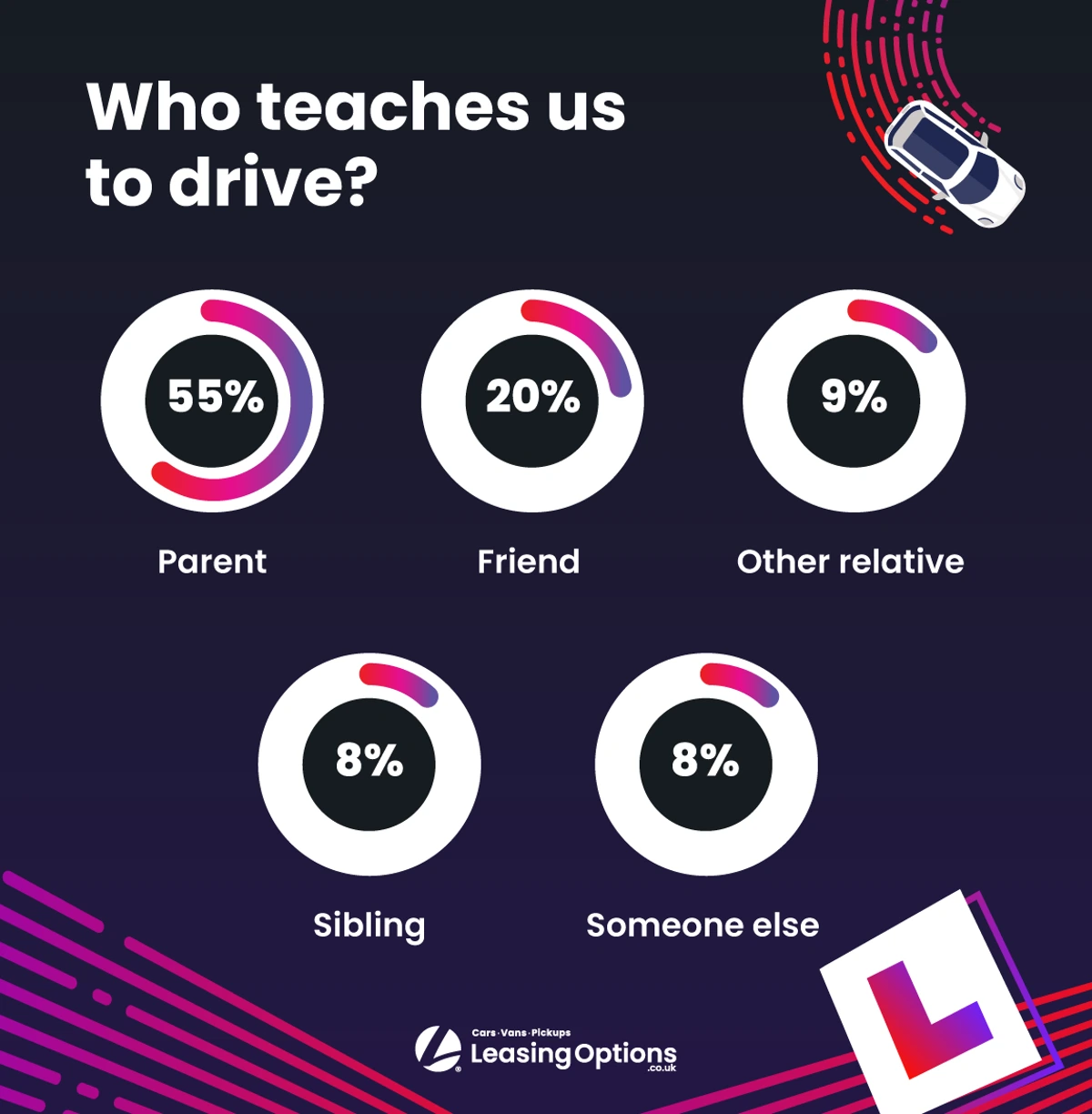
Though you may expect that people would be learning to drive from driving instructors, this isn’t the case for the majority. Over half of survey respondents (55%) said that they learned from their parents, with friends being the next most-commonly used source of driving instruction (20%). These are then distantly followed by other relatives (9%), siblings (8%) and other individuals (8%), proving that new drivers learn from all manner of people.
Considering that parents are the overwhelming default teacher for people learning to drive, it’s likely that this level of closeness will help to form both driving ability and driving behaviour as well. Whether it’s good driving skills or potential bad habits, the chances are that these will be passed on – intentional or not.
Interestingly, different genders have reported that they learned to drive in different ways. Women were more likely to have learned using instructors only (49%), with it being less common for men to do this (42%). Instead, men tended to learn through private practice only (9.5%), with women opting to do this less frequently (7%).
What habits do we pick up from them?
As is the case with anyone we learn from, we’re bound to pick up different skills and habits from whoever teaches us. When it comes to driving, however, we can see that some habits have been passed on more than others.
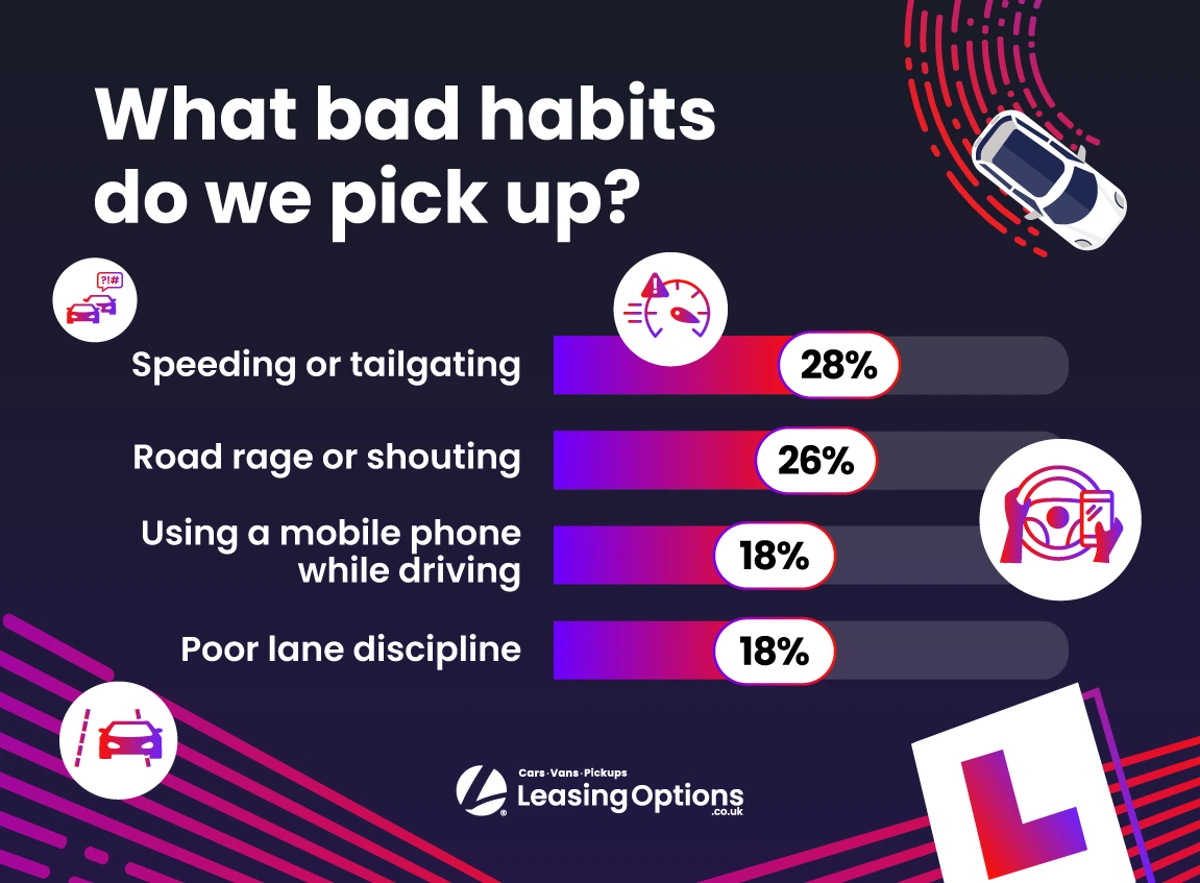
The largest proportion of habits picked up by drivers has been found to be positive (44%), but when they aren’t, it’s often dangerous habits that are passed on instead. For example, speeding or tailgating (28%) and road rage or shouting at other drivers (26%) are the most common bad habits to inherit.
You might expect that these habits are adopted by the newest and younger drivers, but it’s actually older age ranges that say they picked up specific habits instead. The 25-34 age group admits to picking up these bad habits far more frequently than most, with almost half (47%) admitting to speeding or tailgating – 19 percentage points higher than the average (28%) - and a large portion confessing to road rage (43%) – 17 percentage points higher than the average (26%).
Road rage runs in the family
Survey data has also revealed that drivers aged 18-24 are three times as likely to say the person who taught them often showed road rage (39%) – 27 percentage points higher than the average (12%). Those aged 18-24 also showed a greater tendency to admit that they themselves reacted with anger (17%) – 7 percentage points higher than the national average (10%).
Considering that this age group admits to more than one bad habit at a higher rate than the national average, this appears to be a generational pattern rather than a one-off stat.
Moving on to regional data, London stands out as a bit of an outlier, having picked up bad habits at a higher rate than other areas. The capital notably had 29% of residents saying their teacher frequently showed road rage, with nearly a fifth (17%) admitting they reacted with anger themselves, both of which are well above the national average.
There also appears to be a mild gender gap, with men actually reporting that they react with anger often (11.3%) more than women do (9.2%). This potentially shows the different impact that having a male or female driving teacher could have on those learning to drive.
The cost of learning without a car
Learning without a car can be incredibly expensive, with the cost of accessing a car and the price of driving lessons quickly adding up.
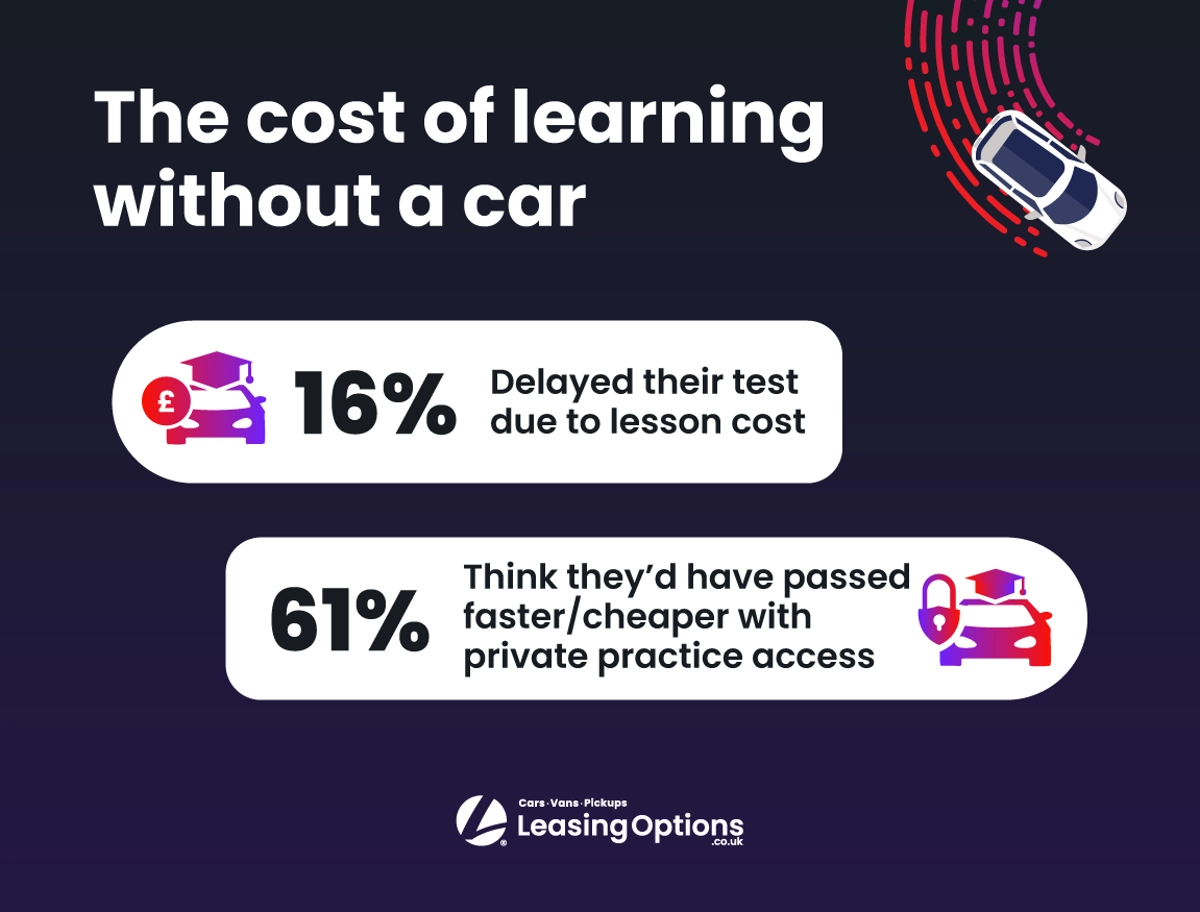
With these steep prices, it’s no surprise that 16% of drivers stated that the cost of lessons delayed their test. Additionally, out of those who didn’t have regular access to a car for private practice, 61% of them believed they would have passed faster or spent less money if they had a car.
This raises the question about the overall cost of learning to drive and how it’s becoming less sustainable for learner drivers – potentially putting people off the idea of learning to drive to begin with.
Pass rates are also not favourable for learners, with it taking the average driver nearly two attempts (1.93) to get their licence, with less than half passing on the first try (42%). Looking at over-65s, however, they have the highest pass rate of any age group, with 50% going on to pass first time, somewhat undercutting the assumption that older generations had it easier when learning to drive.
With pass rates as low as these, it again emphasises the added cost that having to complete an extra driving test will add. Considering that test prices are also rising and becoming increasingly expensive, it doesn’t favour the majority of learners who’ll have to pay for multiple tests.
Mike Thompson, Chief Operating Officer at Leasing Options says, “Habits that young and new drivers develop early on will often end up staying with them for life. If things such as road rage and impatience are being unintentionally passed on from more experienced drivers, it’s something that family members and mentors should be more aware of going forward.
“The cost of learning to drive is also becoming a very real issue nowadays, with prices for car access and tests becoming unaffordable. Addressing this problem will not only benefit young drivers but also create an easier pathway for responsible drivers, benefitting everyone on the road.”
How to lower the cost of driving?
As we’ve already established, learning to drive can be very expensive, with both the costs of tests and accessing a car mounting up. This means that after learner drivers have passed their test, it’s unlikely they’ll have much spending money to put towards a car.
So, what’s the best solution for new drivers?
For newly qualified drivers looking for affordable routes into motoring,car leasing can be a practical option. With lower upfront costs and options to fit monthly budgets, it opens the doors to a wider pool of people, making driving more accessible.
Leasing Options’ special offers are a great entry point for those who’ve just passed their tests, with reasonable pricing that’s able to help reduce the overall cost of driving a car. With other routes to take, likeused car leasing as well, there are plenty of vehicles available for newer drivers needing lower monthly prices.
If you’ve recently passed your test and are unsure or need some extra help, have a read of ourguide to car leasing for young and new drivers to help figure out a suitable solution for you.
Methodology
2,000 UK drivers were surveyed by OnePoll on 6-8 June 2026. Nationally representative sample by age, gender and region.
Supplemented with supporting DVSA data on practical and theory test pass rates by test centre, gender, age bracket and common test faults (Great Britain, 2025-26), used for wider context alongside the survey findings.


